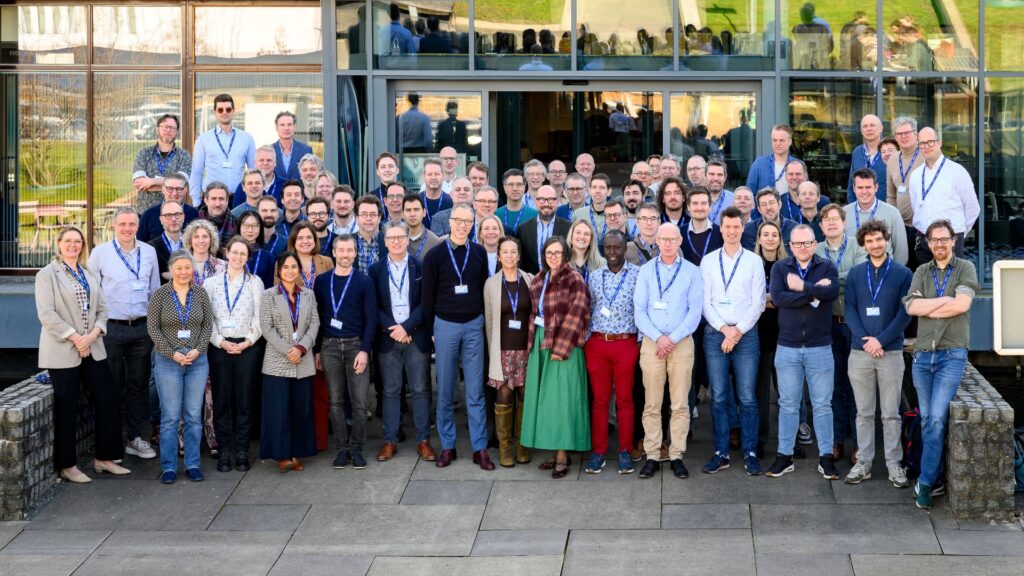
On Friday 22 May, the DigiShape community gathered at Port of Rotterdam for a day about large data files in the water sector. The central question: how do you, as a public party, knowledge institution or market party, effectively deal with growing amounts of data from sensors, models and other data sources?
That question was looked at from several angles. The plenary presentations showed what large data files mean for operational systems at Rijkswaterstaat and KNMI. In the parallel sessions, participants delved deeper into data collection at sea, shared digital infrastructure and the use of data lakes. During lunch and at the end of the afternoon, DigiShape seedmoney was central, with new project ideas for 2026 and updates of projects from 2025.
On this page you will find the retrospective, presentations and project updates.
Plenary presentations by Rijkswaterstaat and KNMI
Floris Langeraert showed how Rijkswaterstaat works with large amounts of data in operational systems, including within RWsOS. His presentation covered various points of attention, such as data flows from multiple sources, monitoring of data quality, reprocessing of historical data and the question of how data can be made more findable and reusable.
Download presentation Floris Langeraert, Rijkswaterstaat (pdf)
Wim Som de Cerff gave an insight into data and data management at KNMI. He showed which types of large datasets KNMI works with, such as weather model data, climate model data, satellite data, observations and warnings. He also discussed the KNMI Data Platform, APIs, user questions and future developments around federated data networks and AI applications.
Download presentation Wim Som de Cerff, KNMI (pdf)

These parallel sessions with a practical approach
MIVSP: information provision at sea
In the parallel session on MIVSP, the Maritime Information Service Point, Martijn van Dijk of Rijkswaterstaat discussed data collection and information provision in the North Sea. This included sensors at sea, storage, access and the use of datasets by various users.
Martijn showed that there is always a “manual” with data, no matter how well datasets are described. Users are asked to be aware of the handling of datasets. Not everything can be compared one-to-one, because there may be differences in the data source or in the way data is processed.
Using examples, he made it clear that we often work with data quite easily and make assumptions in the process. A simple example is clicking away from a disclaimer without reading it, to go directly to the dataset.
This becomes even more relevant when an AI agent picks up data. Such an agent can assume that all data is fully described and clear, and then combine datasets that cannot simply be combined.
The invitation from the session was therefore: talk to the data supplier.
- Download presentation MIVSP, Martijn van Dijk (pdf)
- More information: www.ivopzee.nl
D-OSP: Multicloud Architecture and Captain Hindsight
D-OSP is about digital collaboration across organizational boundaries. The session covered topics such as trust, interoperability, shared infrastructure and the use of data without having to copy or move it all the time.
Floris Langeraert explained the findings from the desk study carried out. In addition, he presented the realization of parts of the architecture and the experiences gained in the process.
The realized infrastructure has been applied, also within the D-OSP project, in the use case Captain Hindsight. The purpose of this use case was to be able to reconstruct incidents and near misses in shipping afterwards. Fedor Baart demonstrated how the developed architecture has been used for this purpose and showed what additional applications are possible with this architecture. Read more in this interview with Fedor Baart.
With these results, the three objectives of D-OSP, the removal of the most important barriers to digital collaboration, have largely been achieved. The developed environment is still active and available. On request, participants of the session can be given temporary access to experience for themselves how the architecture works in practice.
- Download presentation D-OSP, Gert-Jan Schotmeijer, Floris Langeraert and Fedor Baart (pdf)
- Project page D-OSP
- Interview with Fedor Baart about the results of D-OSP
Data lakes and Beacon
Peter Thijsse of MARIS spoke with those present about the question of what “large data files” actually are. This is not only in the size of files, for example in GBs or TBs, but also in the use. Do datasets have to cross the line before they can be used? Is an additional pipeline needed to transform the data? This all plays a role in the question of whether files are perceived as “large” in practice.
After that, MARIS shared experiences with dealing with large datasets. This included harmonization of data, metadata and formats, such as ZARR, Parquet and NetCDF. It also discussed how a smart data access service can help to better use and reuse large data files in addition to the data.
This was demonstrated with a use case with ERA5 data. In addition, a Beacon instance was placed next to this data, for use of very large datasets in Python notebooks within a C3S project for climate change attribution.
Seedmoney 2025: Project Updates
In the afternoon, the three seedmoney projects from 2025 gave an update on their progress.
PortVision
PortVision is working on visibility forecasts for safe shipping in the port of Rotterdam. The update explained how historical visibility measurements and KNMI meteorological data are used for an AI model that can predict visibility conditions in advance. Follow-up steps were also discussed, such as spatial vision predictions and further validation in practice.
KLIC at Sea
KLIC at Sea focuses on up-to-date, reliable and complete information about cables and pipelines at sea. The update discussed, among other things, differences between investigated databases, management, procedures and user needs. The progress towards a draft at the end of June was also mentioned.
Digital Dike
Digital Dike is investigating how a digital twin can contribute to dike management and the duty of care. The update discussed the plan of action, the translation of subsurface data into a 3D digital twin and the application in a proof of concept. The plan of action has been discussed with the project partners and is being finalized.
Download the Digital Dike project update (pdf)
Seedmoney 2026: New Ideas
During lunch, six ideas were pitched for the seedmoney call 2026. The pitch round offered space to share ideas, find possible partners and further refine proposals. The pitched ideas were:
- Data-driven spatial development of the North Sea
- Partners: IHM, MARIS and Nelen & Schuurmans
- Contact person: Sven van Os, Nelen & Schuurmans
- Hybrid Modelling of Salt Intrusion
- Partners: HKV and TU Delft
- Contact person: Gijs Hendrickx, HKV
- Synthetic groundwater levels for water and dike management
- Partners: BZIM, Deltares and UvA
- Contact: Karel Hagemans, BZIM
- Governance AI agents
- Partners: Deltares
- Contact: Bonne van der Veen, Deltares
- AI for infrastructure asset management
- Partners: Deltares, Port of Rotterdam, Rijkswaterstaat
- Contact: Antonis Mavritsakis, Deltares
- Agentic AI training and examination
- Partners: Deltares, TU Delft and Van Oord
- Contact: Gerben de Boer, Van Oord
The proposals will be further elaborated in the coming period and after the summer we will hear which of these projects will be awarded seed money for 2026. Are you interested in one of these ideas or would you like to think about a sequel? Please contact the contact person mentioned.