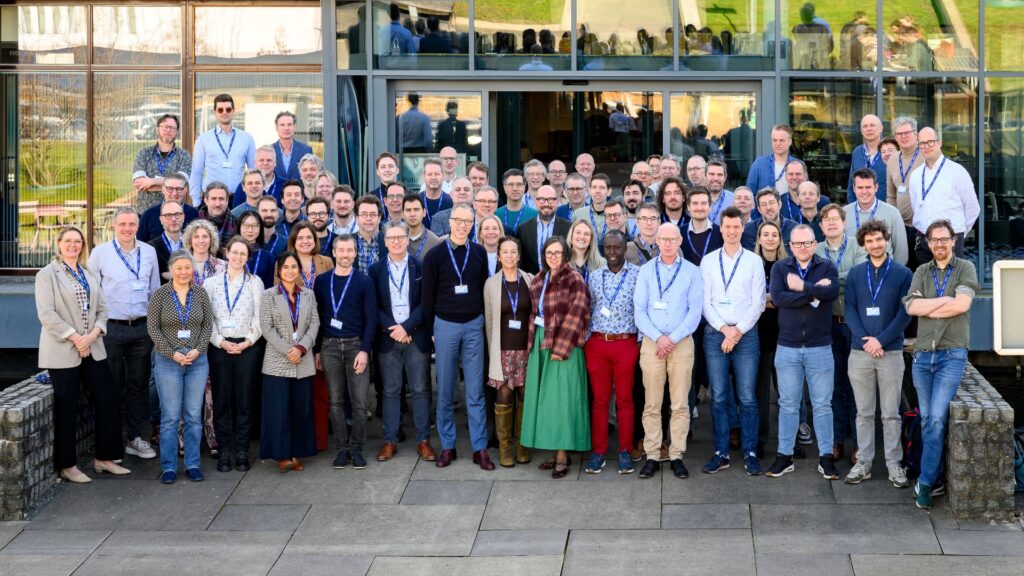
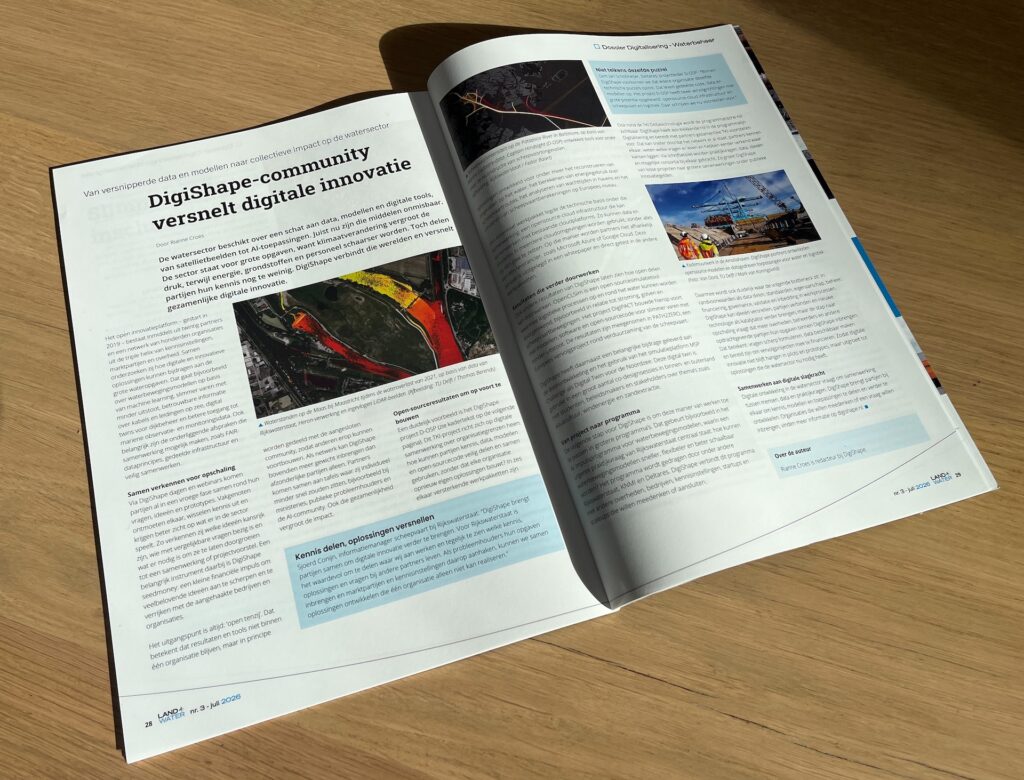
7 November 2025 – DigiShape day at the Port of Rotterdam Authority
How do you get data about soil, water and infrastructure in order in such a way that we can share, reuse and apply it more easily? That question was central to the DigiShape day at the Port of Rotterdam Authority. The day brought public, private and knowledge partners together to move from fragmented data to coherent information and to discover where collaboration makes a difference.
Why this theme is happening now
In his welcome, Bunno Arends emphasised that standardisation is also essential for the Port Authority. From DigiShape, David van den Burg outlined that digital twins, modeling and AI only work if the basis is right: unambiguous data and clear agreements in the chain. The day gave space to see what is already there, where there is a problem and where joint steps are possible.
Plenary presentations
From basic registers to a data system – Ministry of VRO
Martin Peersmann (Ministry of Housing and Spatial Planning) showed how the Zicht op Nederland (ZoN) programme is working on a data system for the physical living environment. This includes three layers: a data foundation, an infrastructure for reliable data sharing, and a network of digital twins. Public and private data are needed for tasks relating to area development, water and soil. Peersmann indicated that the water sector is currently not sufficiently visible in existing data-sharing initiatives, while good connection can actually have a lot of impact.
Martin used the analogue of Michiel de Ruiter’s strategy: “It’s not about how many ships you have to win a battle, it’s about how you make them work together. The same applies to data systems: you can’t solve that in a monodisciplinary way.”
Presentation Martin Peersmann, Ministry of Housing, Spatial Planning and the Environment: Spatial Information (pdf)
Video Circular Soil Flows, Basic Register Subsurface of Sogelink: https://www.youtube.com/watch?v=UjOnBdriLdc
Data standards as a precondition – SIKB
Roeland Heuff showed how SIKB, which has now been in existence for 25 years, works as a foundation in which governments and market parties work together on an infrastructure for quality assurance in the soil chain. An important part of this are the data standards: agreements on how soil and archaeology data are recorded and exchanged. These standards run like a thread through the entire chain, from fieldwork and laboratories to consultancies and governments, so that everyone speaks the same language and data can be used error-free.
Roeland: “Standardization is a verb. It is never finished. And it’s human work.”
Presentation Roeland Heuff, SIKB: Data standards are a prerequisite for the error-free and efficient sharing of information (pdf)
CROW: practice-oriented harmonization
Arie van den Berg (CROW) zoomed in on the DOOR programme, which works on data harmonisation for public space. The INBOR information model will be expanded with dynamic data, such as sensor data.
For hydraulic engineering objects, CROW is exploring two routes: to further expand IMBOR so that hydraulic engineering fits in, or to develop a separate information model for hydraulic engineering that can then connect to INBOR. In doing so, CROW is also looking at the link with the AQO standard of the Water Information House, so that object data and water data come together better. Arie emphasized that adoption and management are just as important as technology, because standards only work if they are used and maintained structurally.
Presentation Arie van den Berg: CROW makes practical knowledge directly applicable (pdf)
Van Oord: information exchange requires shared meaning
Arjen Vos liet zien hoe informatie-uitwisseling in projecten soms minder eenduidig is dan het lijkt. Binnen projecten lukt het vaak goed om data te ordenen en te koppelen aan areaalinformatie, en toch ontstaan er misverstanden zodra meerdere organisaties betrokken zijn. De kern volgens Vos is dat technische communicatie altijd draait om interpretatie. Zoals hij het verwoordde:
We think we understand each other, but often speak different ‘languages’. Communication is the exchange of information in such a way that the other person understands what you mean.
Vos used the maintenance contract for the Rhine branches to show how divergent coding, own working methods and different interpretations can lead to duplication of work and loss of information. He emphasized that real improvement lies in developing shared semantics and building on existing standards, rather than creating new “languages” all the time.
Presentation Arjen Vos, Van Oord: value-driven maintenance contract floodplains – WOCU (pdf)
DigiLab Applied Knowledge: opportunities for the sector
Bas van Vossen showed how DigiLab Applied Knowledge is built as a virtual research facility in which knowledge institutions can securely share and use data, models and algorithms. DigiLab is in line with existing standards and FAIR principles and focuses on cross-domain tasks, such as the nitrogen problem, the pressure on land and water space, safety issues and health issues. The initiative is still in the start-up phase and offers the water sector opportunities to join the first use cases and to jointly tackle bottlenecks around data sharing and governance.
Presentation Bas van Vossen, DigiLab (pdf)
Periplus: the consultant’s vision
Bart van Mierlo showed how fragmented subsea data is now: different standards, problems with conversion between coordinate systems and inconsistencies between databases. At the same time, the need for reliable and shareable information is growing. Examples such as Sonarreg show that cooperation works: one national database for underwater objects to which public and private parties connect.
His advice: start small and build a data space for the North Sea from there, based on existing standards.
Bart: “Er gaat een enorme bron aan informatie verloren die voor iedereen, die iets te maken heeft met de Noordzee, nuttig zou kunnen zijn.”
Presentation Bart van Mierlo, Periplus: the North Sea as a single data platform (pdf)
Parallel sessions – the yield at a glance
1. Collaboration between Van Oord and RWS (Gerben de Boer)
In three small groups, lively conversations arose about the usefulness and necessity of standards. At the same time, it became clear that standards do not solve everything and that good communication between asset owner and stakeholders remains indispensable.
In practice, many parties still work with simple tools such as Excel, and new developments do not always directly connect to existing standards. The group also explored how to incorporate future multifunctional objects at sea or natural elements such as willows into a domain ontology. A striking comparison came from archaeology, where each object is immediately given a unique code. This raised the question of whether we should not do the same in hydraulic engineering.
Presentation Gerben de Boer, Van Oord: Collaboration data in the chain (pdf)
2. DigiLab Deltares (Gert-Jan Schotmeijer)
There was a lot of enthusiasm in the group and a strong conviction that DigiLab can play an important role in harmonization and standardization within our sector. A clear link with the morning presentations was that DigiLab should be in line with existing standards as much as possible to prevent fragmentation and encourage collaboration.
Several interesting use cases emerged, including an example about the energy transition and its impact on groundwater and therefore on drinking water. This illustrates how DigiLab can contribute to connecting data and processes in practice, both now and in future assignments. These examples show that DigiLab is not just a concept and that it can be a catalyst for innovation and efficiency.
3. High performance data lake IHM–MARIS (Peter Thijse & Pim van Avesaath)
As a follow-up to the IHM-MARIS Beacon session (with live demo) in the afternoon, MARIS is organizing an in-depth DigiShape webinar on this data lake technology on Wednesday 10 December from 9 to 10:15 am.
The technology behind the Beacon data lake sparked a lot of interest. Beacon is an open-source technology that makes vast amounts of measurement data easily indexable and searchable at lightning speed, allowing users to flexibly filter all attributes, such as area, period and parameters, as well as access different data sources as one virtual lake. Beacon has so far been applied to large collections of marine data, but is suitable for any data collection with measurement data and data grids, thus providing a promising building block for the data managers in the DigiShape community and beyond.
IHM-Maris presentation about Beacon at the live demo (pdf)
What now?
The day showed that the building blocks are there, but that collaboration, standardization and governance determine whether data will really flow. In the coming months, DigiShape will explore how we can bundle the bottlenecks that have been identified and whether programmatic cooperation on harmonization is possible.
Would you like to think along, share a case or join follow-up sessions? Please contact David van den Burg.