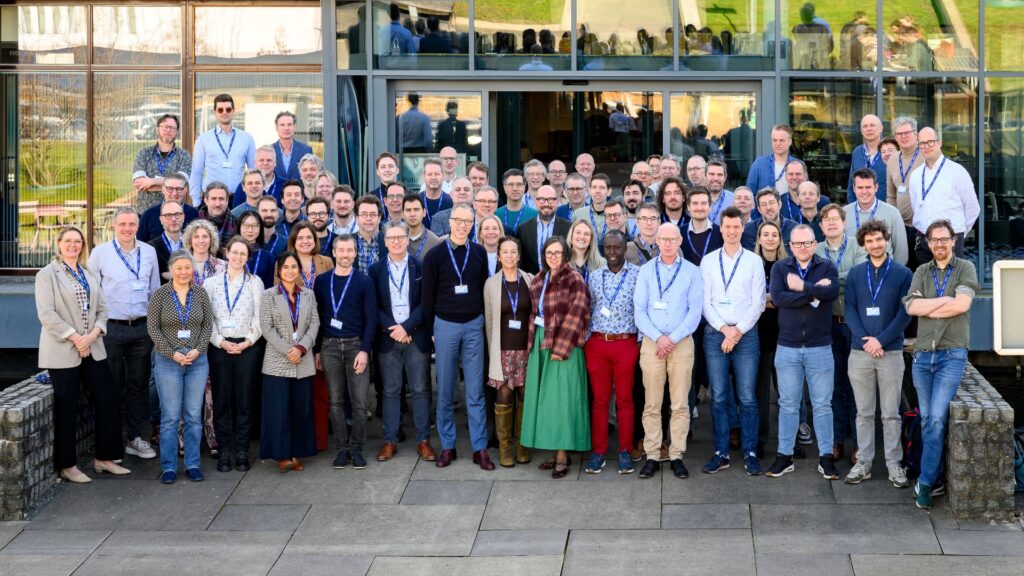
DigiShape day – AI Impulse Program for water movement models
On Tuesday 27 May, DigiShape and Rijkswaterstaat are organising a meeting about the AI Impulse Programme for Water Movement Models. This four-year programme focuses on the development of datasets and advanced machine learning (ML) models for the RWS Main Water System (Rivers, IJsselmeer Region, Coast) that can be used, among other things, for the operationally rapid calculation of (weather) scenarios.
Why this impulse programme?
The current (numerical) water movement models used at Rijkswaterstaat are limited in speed and flexibility. For example, a hydrodynamic 2D model for the North Sea now has at least five hours of computing time per run. An ML model can do this in less than a minute, allowing more scenarios to be calculated.
ML and deep learning (DL) are already proven technologies in industries such as medical, meteorology, and process automation. The challenge is not in the technology itself, but in its application within the main water system. This requires a strong boost: large-scale integration of models and data, cooperation between parties and adaptation of work processes in the sector.
Collaboration and partners
The programme is supported by Rijkswaterstaat in collaboration with KNMI, Deltares and Digishape, among others. Other governments, companies, knowledge institutions, startups and scaleups are welcome to join.
What can you expect on the DigiShape day?
This day offers an opportunity to get to know the program better, discuss current initiatives and collect ideas. The program includes:
- Presentations on the background, the initiative and the objectives;
- Explanation of current initiatives (including RWS, KNMI, Deltares);
- Program alignment and input retrieval;
- Formulating “use cases” together
- Presentations of partner initiatives.
Program
09:30 – 10:00 Walk-in
10:00 – 10:45 Explanation of the programme
By David van den Burg (DigiShape), Annette Zijderveld and Joost Driebergen (RWS)
10:45 – 11:45 Short pitches ongoing projects
By Martin Verlaan of TU Delft, Henk van den Brink of KNMI, Caroline Gautier and Hans Korving of Deltares and FloodWaive
11:45 – 12:15 Exploration of the design of the programme
By a purchasing consultant from Rijkswaterstaat WVL
12:15 – 13:15 Lunch
13:15 – 14:15 Round 1 interactive session
The following four topics will be covered in the afternoon program. We will discuss together how this subject fits within the goals of the Impulse Programme.
1. Link user stories to use cases
An important aspect within the start-up phase of the Impulse Program is to get the user questions (user stories) in focus so that we can choose a technical solution that matches the user questions. Where possible, we link multiple user stories that overlap so that we can answer multiple questions from a technical solution.
2. Datasets and ICT infrastructure
A well-functioning ML model starts with accessible, reliable and up-to-date data. At the same time, this places demands on the technical infrastructure and data management. Questions that play a role in this are:
- How do you manage a dataset, and which aspects play a role in this (ownership, quality, metadata)?
- How do you provide an infrastructure that makes it possible to easily access datasets for model development and training?
- How do you set up data lifecycle management? Think of keeping datasets up-to-date, version management, and data refreshment.
3. Algorithm
Within this topic, we want to reflect on the challenges involved in operationalizing Machine Learning models. Within the Impulse Programme, the focus is on putting an algorithm / model into use that meets the user demand and is suitable for daily operational use.
4. Explainability and governance
In the successful implementation of Machine Learning models from the Impulse Programme, decisions are made or actions are carried out based on the results of these models. Explainability is important in this context to understand how and why an ML model makes certain predictions. This is also important for trust and acceptance by the (end) user of these often complex models. Governance is necessary to ensure that (among other things) it is clear what a model must meet before it goes into production, what the model may be used for and to ensure that laws and regulations are complied with.
14:15 – 15:30 Round 2 interactive session
15:30 – 16:00 Summary, closing
16:00 – 17:00 Drinks