

This initiative has been awarded €10,000 DigiShape seed money in 2026. Read the news item
Learning the Missing Physics
HKV, TU Delft, Rijkswaterstaat and the Port of Rotterdam Authority are working on a hybrid model for predicting salt intrusion. The model combines the strengths of physical models with AI models.
Modelling and predicting salt intrusion is complex due to the hydrodynamic interactions that play a role in this. 3D models are often used for this type of calculation. However, these models require a lot of computing power. AI models, once trained, are less computationally intensive, but do not automatically take into account known physical limits.
Within this seed money project, a hybrid model is therefore being developed in which a physical model forms the basis and an AI layer is used to supplement the missing knowledge in this model.
Challenge and approach
A two-dimensional vertical (2DV) physical model is used as a basis. This ensures that known physical processes in the delta are included in the predictions. The AI layer is added to fill in the so-called knowledge gaps of the physical model, in particular the calibration parameters.
Dynamically updating these calibration parameters based on the state of the delta should enable a more representative prediction of salt intrusion.
Within the project, the interactions between the physical model and the AI model will be investigated, the existing 2DV model will be adapted for hybrid modelling and data will be collected and prepared for training. The hybrid model is then developed and performance is evaluated.
Intended results
The seedmoney stage delivers:
- a hybrid model in which a 2DV physical model is supplemented with an AI layer;
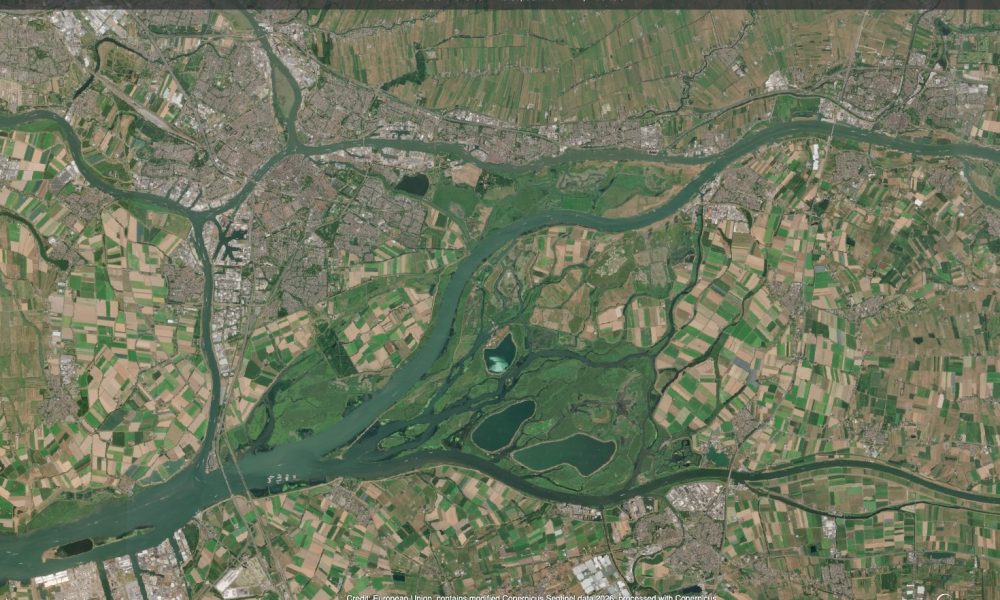
- application of this model to one Dutch estuarine system, for example the Rhine-Meuse estuary;
- an evaluation of the performance of the hybrid model.
The model is made available open source.
The intended end users include Rijkswaterstaat, coastal provinces, water boards and other parties working on issues related to salt intrusion. Both in Dutch deltas and abroad.
Partners
- HKV is the project leader and carries out the technical work.
- TU Delft provides technical support.
- Rijkswaterstaat and the Port of Rotterdam Authority are involved in the content.
- Other parties are invited to join and contribute to the project.
Continuation
Because the model is location-dependent, in some cases the final product can be used directly as an open-source model. In other cases, it serves as a proof of concept for application in other areas.
A possible next step is therefore the development of similar hybrid models for other locations.
Role of DigiShape
DigiShape supports the project from Seedmoney 2026 and brings the knowledge gained to the attention of the DigiShape community.
