

This initiative has been awarded €10,000 DigiShape seed money in 2026. Read the news item
Towards a thorough methodology
BZ Ingenieurs & Managers, Deltares and the University of Amsterdam are working on a methodology for the development of a data base for future AI and machine learning applications on groundwater.
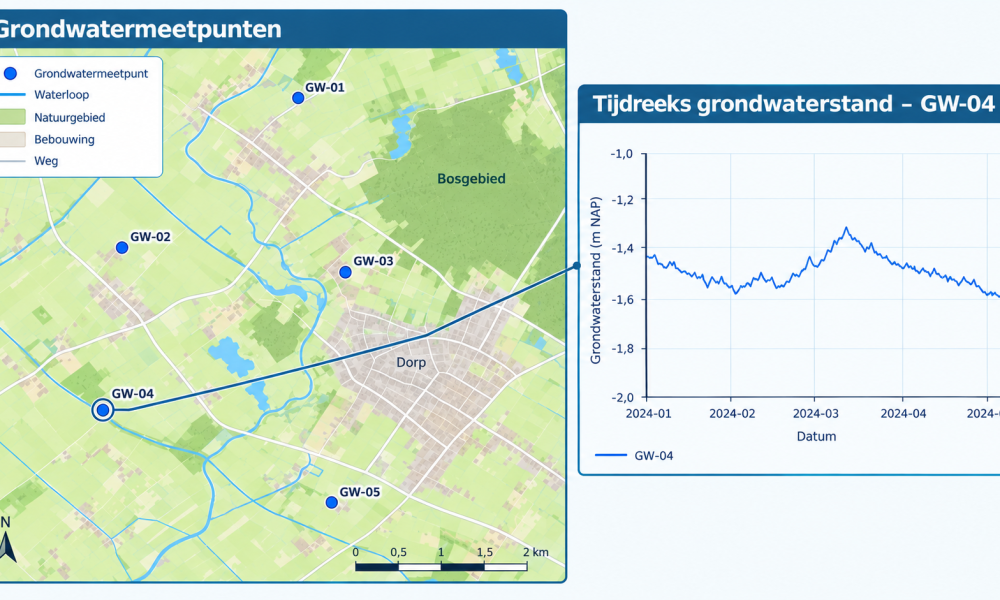
Groundwater analyses depend on monitoring well data. The coverage of these monitoring networks can be limited, while expansion of monitoring networks is expensive and not always practically feasible. This creates uncertainty in groundwater analyses at locations where no or only limited measurement data are available.
In recent years, developments in AI, machine learning, and physics-based groundwater models have created new opportunities to generate groundwater series. However, in order to be able to apply such techniques reliably, a robust methodology is first needed that clearly defines which models are suitable, what data is required and how this data must be prepared.
An initial inventory shows that the success of an AI/ML-driven solution is not primarily determined by the AI/ML model itself, but by the quality of the underlying methodology and training data. Therefore, this seedmoney project does not focus on the development of an AI/ML model, but on the development of a methodology that can be used to generate reliable groundwater levels at any location that are suitable for geohydrological and dike strength analyses.
This methodology forms the basis for a follow-up project in which a Proof of Concept is actually developed with a prototype model.
Objective
The aim of this project is to develop a methodology with which groundwater levels (generated data series) can be generated at any location, where the results are sufficiently reliable to perform accurate geohydrological and dike strength analyses.
The methodology describes:
- which types of groundwater models are suitable as a basis and which AI/ML or interpolation techniques are suitable for this;
- which data sources are necessary;
- which environmental variables should be part of the model;
- how to build a high-quality data package for model training and validation.
Phasing
The project consists of four successive phases.
Phase 1 – Planning/methodology
- Determining the research question.
- Defining the functional requirements.
- Delineate the intended application.
- Drawing up the principles for the methodology.
Phase 2 – Inventory of suitable models
- Inventory of existing groundwater models.
- Inventory of existing AI and ML techniques.
- Assessing the applicability of different model concepts.
- Defining the advantages and disadvantages of the different approaches.
Phase 3 – Model selection
- Selecting the most suitable model concept.
- Determine which input parameters are necessary.
- Define the required environment variables.
- Describe how model validation can take place in a follow-up project
.
Phase 4 – Inventory of data and preparation of data package
- Inventory of available data sources (BRO, DINO, KNMI, Rijkswaterstaat and
internal datasets). - Identify what data is missing.
- Designing a uniform data structure.
- Creation of a data package suitable for future model development.
Intended results
After completion of the project, the following results will be available:
- A detailed methodology for generating reliable groundwater levels at random locations;
- An inventory of suitable model concepts, including substantiated model choice;
- An inventory of available data sources and required additional data;
- A first step towards a structured data package, which serves as the basis for a follow-up project in which a Proof of Concept prototype model is developed;
These results form the foundation for a follow-up phase in which the methodology will actually be implemented and validated within an operational prototype model for geohydrological and flood risk management applications.
The intended end users are geohydrologists and engineers who perform groundwater analyses.
Partners
- BZ Ingenieurs & Managers is the project leader and contributes geohydrological knowledge, data and validation.
- Deltares focuses on the integration of data into AI/ML models and quality assurance.
- The University of Amsterdam is supervising the development towards an AI/ML model and contributing to data and functional specifications.
Continuation
This methodology forms the basis for a follow-up project in which a Proof of Concept is actually developed with a prototype model.
Role of DigiShape
By systematically combining existing groundwater models, data sources and AI techniques, a generic methodology for generating groundwater series is created. This is an important step towards data-driven groundwater management and digital support for flood risk management and water management tasks.
DigiShape supports this project with €10,000 in seed money in 2026. In addition, the developed methodology will be shared within the DigiShape network and the project will form a starting point for follow-up research and future implementation.
